 English
 Deutsch
 Español
 Français
 Italiano
 Português
 Русский
 العربية
 हिन्दी
 日本語
日本語 简体中文
简体中文

 Android
 iOS
iOS Mac
Mac Windows


Antivirus AI for Android Verified Again Under DEKRA MASA L1 — Verified App Security Meets AI Protection
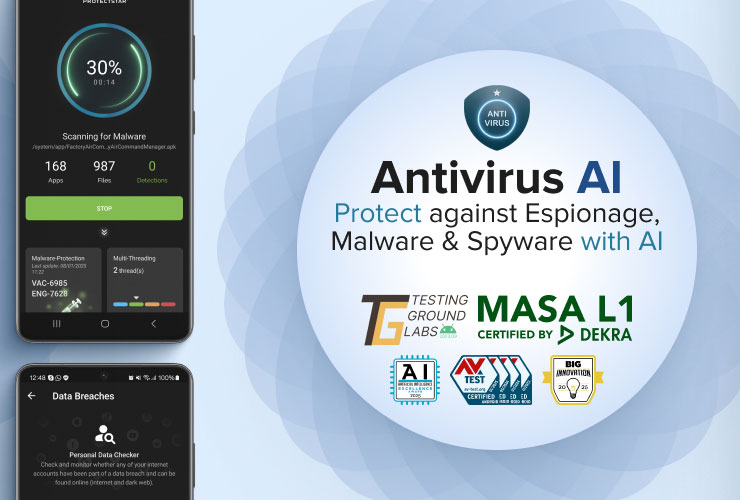
Your smartphone is far more than just a phone today. It is your messaging hub, banking hub, photo archive, office, and much of your personal life all in one. That is exactly why simply installing just any security app is no longer enough. If an app is supposed to protect you, it also has to be built in a particularly clean, robust, and trustworthy way.
That is exactly where DEKRA MASA L1 comes in. And we are pleased to share an important update: Antivirus AI for Android has once again been verified under DEKRA MASA L1.
We already reported on Antivirus AI’s first DEKRA MASA L1 recognition in April 2025. The latest report now confirms that standard once again, with an updated assessment of the Android version that was reviewed.
What DEKRA MASA L1 Means for You
Many people look first at the detection rate when choosing an antivirus app. That matters, but it is not everything. Just as important is the question of whether the app itself was developed securely.
MASA stands for Mobile Application Security Assessment and is, at its core, an independent security review for mobile apps. It is not only about what an app can do, but also about how it handles data, how securely it communicates, and how cleanly it is implemented from a technical standpoint.
In the current report, DEKRA describes the review as a security assessment based on a limited set of methods from the OWASP Mobile Application Security Verification Standard. Put simply, it is about established security benchmarks for mobile apps. To do this, DEKRA combines different types of testing, including developer-provided information, responses to findings from static analysis, and automatically verifiable checks. For you, that means this is not just marketing language—it is a set of documented security criteria in a transparent assessment report.
What the Current DEKRA Report Confirms for Antivirus AI
The report marks the relevant MASA L1 requirements for Antivirus AI as “Pass.” These are precisely the areas that matter most in a security app. Among other things, it states that no sensitive data is written to app logs, that sensitive content is not unnecessarily exposed through the user interface, and that keyboard caching is disabled for sensitive input fields. In everyday use, that mainly means one thing: fewer unnecessary data remnants, less exposure of sensitive information, and less potential attack surface.
The report also paints a clear picture when it comes to encryption. According to the report, Antivirus AI does not rely solely on hard-coded symmetric keys to protect sensitive data, uses proven cryptographic primitives, does not use algorithms considered outdated, and uses secure sources of randomness where required. That may sound technical, but in practical terms it means the protective mechanisms are not just present—they are built on a modern, resilient foundation.
Secure communication with external systems is just as important. The report confirms encrypted data transmission via TLS, TLS settings closely aligned with current best practices, and verification of the X.509 certificate when a connection is established. It also highlights core aspects of app hardening: minimal permissions, validated and, where necessary, sanitized input from the UI, intents, custom URLs, or network sources, a clean release build with no lingering debug artifacts, and enabled security features in the toolchain. Details like these often determine whether an app remains resilient when it is truly put to the test.
This is not just about detecting malware. It is about making sure the protection app itself does not become a vulnerability. And that is exactly what matters in mobile security.
Why This Re-Verification Matters So Much
By nature, an antivirus app has especially deep access to your device. It scans files, evaluates suspicious activity, processes security events, and accesses sensitive areas of the system to do so. That makes it all the more important that it is not only strong in terms of functionality, but also well engineered under the hood.
That is why the renewed DEKRA MASA L1 verification is far more than a logo or a nice seal. It is independent confirmation that Antivirus AI is optimized not only for detection, but also for secure app architecture, robust data paths, and clean development processes. This combination is exactly what turns a good security app into a trustworthy one.
AI Protection That Responds Quickly Without Sacrificing Your Privacy
Modern attacks are evolving faster than ever. That is why Antivirus AI uses an AI approach that starts directly on your device. In our in-depth article on AI protection, we describe the principle like this: The app analyzes files, app activities, and—if enabled—network connections locally. If the AI detects a suspicious pattern of behavior, no personal content is uploaded. Instead, an anonymized fingerprint made up of hash values and metadata is created. That is how fast protection is delivered without your private content unnecessarily leaving your device.
This fingerprint is processed in encrypted form in the Protectstar AI CLOUD and compared there with known threat patterns. If a new pattern is confirmed, a suitable countermeasure is generated automatically and, according to our detailed article, is often distributed within seconds and generally in less than 60 seconds. At the same time, Protectstar describes this approach as Privacy by Design, with TLS-encrypted data paths, no trackers, and no data being sold.
The Overall Picture Became Even Stronger in 2025
The renewed DEKRA verification does not stand alone. It fits into a broader picture that became especially visible in 2025. In our article about Antivirus AI’s third consecutive AV-TEST success, we reported a 99.8% detection rate and a false alarm rate of 0 in the February 2025 test. That exact combination matters to users: a high detection rate against real malware without harmless apps constantly being blocked by mistake.
That was complemented by the BIG Innovation Award 2025. Our article on the award especially highlights that Antivirus AI stood out for its combination of artificial intelligence and dual-engine technology. It also notes that this technological direction was a key reason for the recognition.
Antivirus AI also received the AI Excellence Award 2025. According to our article, it was honored in the Software-Small category (1–100 employees). The article frames the award as recognition for innovation, real-world impact, and the measurable success of AI-based solutions.
Conclusion: This Is Exactly What Modern Mobile Security Should Look Like
When you choose a security app for Android today, you should not ask only whether it detects threats. You should also ask how it was built, how responsibly it handles data, and whether its quality has been independently validated.
That is exactly where Antivirus AI stands out. The renewed DEKRA MASA L1 verification confirms the app’s security foundation for the Android version that was assessed. The AV-TEST results we reported in 2025 underscore its protective value in everyday use. And the awards from 2025 show that Antivirus AI is not just another traditional virus scanner, but a modern, AI-powered security solution with a clearly demonstrated innovative edge.
Ich kann dir den Text auch noch in einen etwas marketingstärkeren US-Blogstil glätten, falls du eine publikationsreife Version möchtest.
 Go back